
Non-compete clauses are a prevalent element in employment contracts, especially within industries where the possession and control of proprietary knowledge and trade secrets are crucial to maintaining a company’s competitive...


Non-compete clauses are a prevalent element in employment contracts, especially within industries where the possession and control of proprietary knowledge and trade secrets are crucial to maintaining a company’s competitive edge. These legal agreements are strategically crafted to prevent employees from entering into direct competition with their former employers, applying both during their tenure and following their departure from the company. They serve not only as protective barriers safeguarding sensitive information but also as a means to preserve the business’s market position by preventing former employees from using insider knowledge to benefit competitors or to start a competing business.
This article delves into the multifaceted nature of non-compete clauses, examining their strategic purpose, the varying degrees of legal enforcement depending on jurisdiction, and the ethical dilemmas they present. The discussion will provide a thorough exploration of the ways in which these clauses are designed to protect critical business interests, such as proprietary processes, client relationships, and specialized knowledge. Additionally, it will address how these clauses attempt to strike a balance between the legitimate business needs of the employer and the employment rights and freedoms of the employee, thus highlighting the complex interplay between economic benefits and individual liberties.
Non-compete clauses, or non-competition agreements, are legally binding contracts where an employee agrees not to engage in business activities that compete with their current or former employer. These clauses are often justified by employers’ needs to protect sensitive information, including trade secrets, client lists, and business strategies. The rationale is that employees, through their employment, have access to confidential information that could be used to give a competitor an unfair advantage.
The primary purpose of non-compete clauses is to protect a company’s confidential information and maintain its competitive advantage. When companies invest significant resources in training employees and developing innovative products and strategies, there is an inherent risk that this proprietary information could be transferred to competitors if employees move to other companies in the same industry. Non-compete clauses aim to mitigate this risk by restricting the ability of employees to work in similar industries for a certain period after leaving the company.
These clauses also help preserve customer relationships developed by the employer. An employee who leaves a company might have built strong relationships with clients, and without a non-compete clause, there’s a risk that these clients could be taken to a competitor. Thus, non-compete agreements protect not just intellectual property but also the stability and integrity of a business’s client base.
The enforceability of non-compete clauses varies significantly between different jurisdictions. In the United States, for example, the enforceability of these clauses is largely determined by state law. California, for instance, is known for its general prohibition against non-compete clauses, viewing them as harmful to competition and employee mobility. Conversely, states like Texas and Florida tend to enforce non-compete clauses more rigorously, provided they meet certain criteria such as being reasonable in scope, geography, and duration.
Courts typically look for a balance between protecting the business’s interests and not unreasonably restricting an individual’s ability to find employment. A non-compete clause deemed too broad in its geographical scope or duration is less likely to be upheld. The key criteria include:
While non-compete clauses are legally enforceable in many places, they raise several ethical issues. Critics argue that these clauses limit employment opportunities for individuals and can hinder overall industry innovation by preventing the free movement of skilled labor. They also potentially force employees to stay with a company out of necessity rather than choice, which could affect job satisfaction and personal career growth.
Moreover, there are concerns about the power imbalance these clauses often represent. Employees, especially those in lower-tier positions, might not have the negotiating power to refuse a non-compete clause and may not fully understand the implications of signing such an agreement.
One of the primary limitations of non-compete clauses is the requirement for reasonable geographic and temporal restrictions. A clause that is too broad in terms of the area it covers or the duration it spans is likely to be viewed as unreasonable and unenforceable. For instance, a clause prohibiting an employee from working in a similar industry worldwide for a decade would likely be deemed excessively restrictive.
The scope of activities restricted by the non-compete must also be reasonable and specific. A clause that is vague or overly broad in defining the restricted activities can render the agreement unenforceable. For example, a clause preventing an employee from engaging in any type of work in a broad industry could be seen as too restrictive.
Another key aspect is the timing and consideration of the agreement. In many jurisdictions, for a non-compete to be enforceable, it must be executed at the start of the employment relationship or supported by additional consideration if introduced after employment has begun.
In the U.S., state laws greatly influence the enforceability of non-compete clauses. Some states have specific statutes that govern these agreements, while others rely on case law. Furthermore, there has been growing federal interest in regulating non-compete agreements, particularly in relation to low-wage workers.
The central challenge in applying non-compete clauses lies in balancing the interests of the employer and employee. Employers argue that these clauses are necessary to protect their business from unfair competition and to safeguard their investment in training and developing their employees. On the other hand, employees and labor advocates contend that non-competes can be used abusively to limit workers’ mobility and bargaining power.
Recent years have seen a trend towards more stringent regulation of non-compete clauses. Some jurisdictions have introduced laws that limit the use of non-competes, particularly for low-wage workers. There is also an increasing recognition of the need for transparency and fairness in these agreements.
Non-compete clauses are frequently the subject of legal challenges. Courts are increasingly scrutinizing these agreements, especially in cases where they appear to be used to unjustly limit an employee’s future employment opportunities. Public policy considerations are also playing a more prominent role in the adjudication of these clauses.
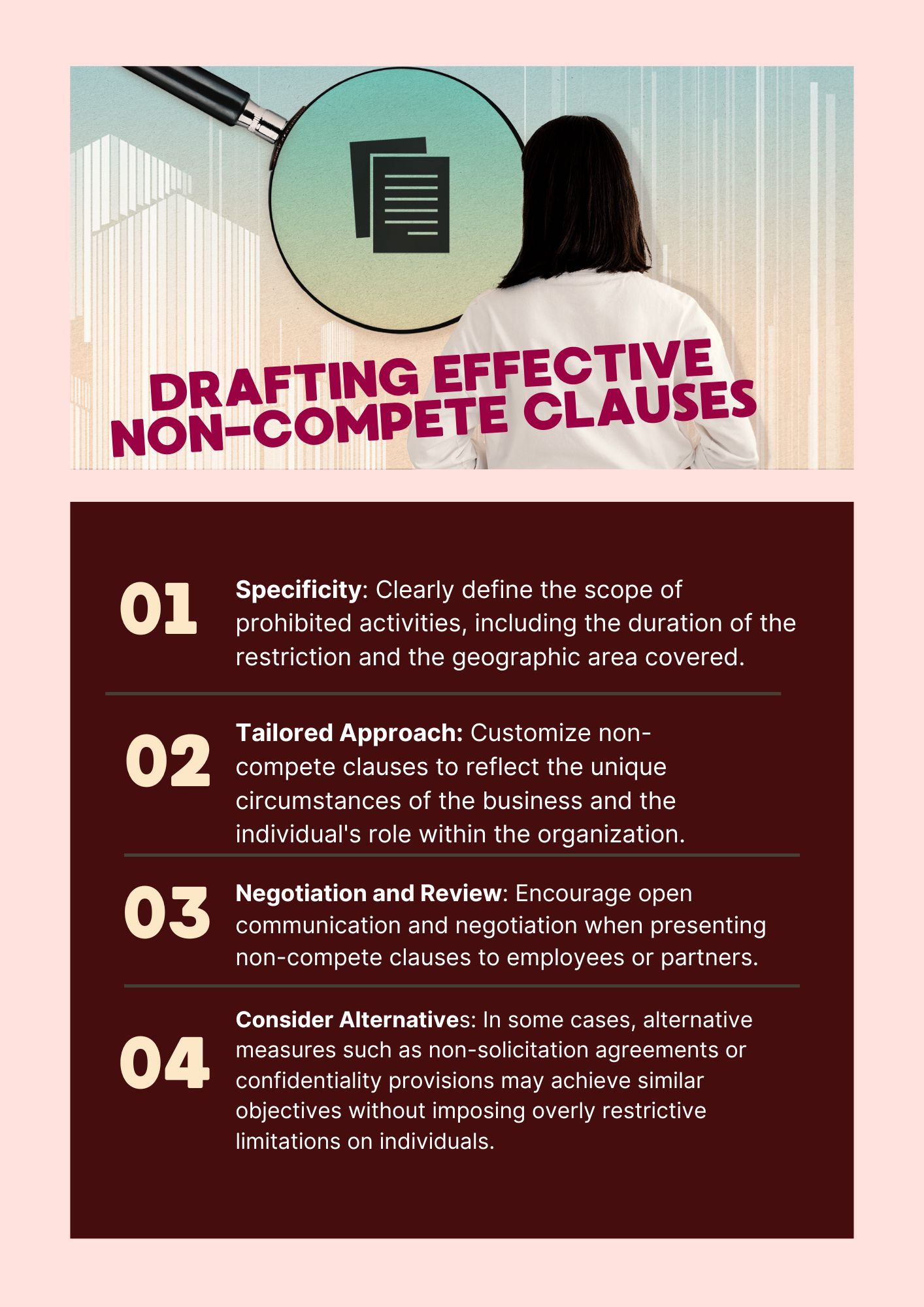
To maximize the enforceability of non-compete clauses while minimizing the risk of legal challenges, businesses should consider the following best practices:

In the event of a breach of a non-compete clause, businesses may pursue legal remedies to enforce the terms of the agreement and seek damages for any harm caused. However, enforcement actions must be pursued judiciously, taking into account the likelihood of success and the potential reputational risks associated with litigation.
Non-compete clauses play a vital role in protecting businesses’ interests and preserving their competitive advantage. However, their enforceability hinges on careful drafting, consideration of legal standards, and adherence to best practices. By understanding the limitations and nuances of non-compete clauses, businesses can develop effective strategies to safeguard their interests while respecting the rights of employees and partners.
For employers, the key to creating effective and enforceable non-compete clauses lies in understanding and respecting the balance between protecting business interests and respecting employees’ rights. Here are some best practices:
Non-compete clauses play a crucial role in protecting business interests, but they must be balanced against the rights and freedoms of employees. As the business environment continues to evolve, so too must the approach to these agreements. By crafting reasonable and clear non-compete clauses, and considering ethical implications, companies can protect their interests while fostering a fair and competitive market. Employers must navigate this delicate balance carefully to maintain a loyal, innovative, and motivated workforce.
Non-compete clauses are a complex and evolving aspect of employment law. While they serve a legitimate purpose in protecting business interests, their application is bounded by legal and ethical considerations. Employers must carefully craft these clauses to ensure they are reasonable and enforceable, while also respecting the rights and freedoms of employees. As legal landscapes and societal norms continue to evolve, so too will the interpretation and enforcement of non-compete clauses. Both employers and employees must stay informed and considerate of these changes to navigate this challenging aspect of employment relationships effectively.
Did you find this Legitt article worthwhile? More engaging blogs about smart contracts on the blockchain, contract management software and electronic signatures can be found in the Legitt Blogs section. You may also contact Legitt to hire the best contract lifecycle management services and solutions.
A non-compete clause is a part of an employment contract that restricts employees from working in similar industries or starting competitive businesses after leaving a company.
Companies use non-compete clauses to protect proprietary information, maintain competitive advantage, and preserve customer relationships.
The enforceability of non-compete clauses varies by jurisdiction. For example, California generally prohibits them, while states like Texas and Florida enforce them under reasonable conditions.
Non-compete clauses should be customized to reflect the unique circumstances of the business and individual roles, avoiding a one-size-fits-all approach.
Alternatives include non-solicitation agreements, confidentiality provisions, and other measures that achieve similar objectives without overly restricting individuals.
Legal considerations include compliance with applicable laws and regulations, consideration of public policy implications, and adherence to contractual standards.
Breaches may result in legal action, enforcement of contractual terms, and potential damages for harm caused to the business.
Businesses should pursue enforcement judiciously, considering the likelihood of success and potential reputational risks associated with litigation.
Open communication and negotiation allow for mutual understanding and the potential modification of non-compete terms to accommodate both parties' interests.
Understanding non-compete clauses helps businesses protect their interests and individuals navigate contractual obligations while preserving their rights and opportunities.
A non-compete clause must be reasonable in scope, duration, and geography, protect legitimate business interests, and align with public interest to be enforceable.
Yes, if a non-compete clause is excessively broad in its geographic scope or duration, courts may deem it unenforceable for restricting an individual's employment opportunities unnecessarily.
Legitimate interests include trade secrets, proprietary information, and substantial customer relationships that a company reasonably wishes to protect.
It can raise ethical concerns, particularly if applied to employees without access to sensitive information, as it may unnecessarily hinder their future employment opportunities.
Employers should tailor clauses specifically to the needs of the position, ensure the duration and scope are minimal, and provide clear communication about the terms.
Alternatives include non-solicitation and confidentiality agreements, which can protect business interests without fully restricting future employment opportunities.
Yes, employees should attempt to negotiate non-competes to ensure they are reasonable and do not overly restrict future job opportunities.
If enforced, the employer may seek legal remedies such as injunctions or damages against the employee for breach of contract.
No, it should be limited to similar industries or direct competitors where the risk of business harm is substantiated.
Yes, industries that rely heavily on trade secrets or proprietary processes, like technology, engineering, and pharmaceuticals, often use non-compete clauses.
Typically, 6 months to 2 years, depending on the industry and the employee’s role, are considered reasonable durations.
Public interest considerations include whether the clause restricts fair competition and innovation or impacts the availability of skilled labor in critical industries.
While legally possible, it is often considered unethical to impose strict non-compete clauses on lower-level employees who do not access critical business information.
The geographic scope should be limited to areas where the employer actually conducts business and faces real competitive threats.
A non-compete restricts future employment opportunities, while a non-disclosure agreement specifically prohibits the sharing of confidential information.
Yes, overly restrictive non-compete clauses can limit professional opportunities and personal career development.
Compensating employees during the restrictive period of a non-compete can be a fair practice, acknowledging the limitation placed on their career opportunities.
Top of Form