
Contract review plays a vital role in ensuring the legality, accuracy, and compliance of agreements. It involves a meticulous examination of contract clauses, terms, and provisions to identify potential risks,...

Contract review plays a vital role in ensuring the legality, accuracy, and compliance of agreements. It involves a meticulous examination of contract clauses, terms, and provisions to identify potential risks, negotiate favorable terms, and protect the interests of all parties involved. With the advancement of technology, contract review software has emerged as a powerful tool to streamline and enhance the contract review process. This article serves as a comprehensive guide to contract review software, covering its importance, key stakeholders, best practices, common mistakes, and the role of Legitt AI in simplifying contract review.
Contract review is the process of thoroughly analyzing and understanding a legal contract before signing to its terms. It involves a detailed examination of the contract’s language, clauses, provisions, obligations, and rights to ensure clarity, accuracy, and enforceability. Legal contract review aims to identify potential risks, ambiguities, inconsistencies, and areas where negotiations or revisions may be required. It is a crucial step in mitigating legal and financial risks, protecting parties’ interests, and ensuring essential elements of a contract with applicable laws and regulations.
You may also like: What is a CLM
The purpose of a contract review is to make sure that legal agreements and the clauses contained within them are strong, and that legal and financial risk is minimized to safeguard your company’s interests. Contract review is essential for several reasons:

You may also like: What can contract management software ensure
Contract review involves various stakeholders, depending on the nature and complexity of the agreement:
Legal Professionals: Lawyers or legal teams specializing in contract law have the expertise to review and assess the legal implications of contract clauses, ensuring their legality and compliance.
Business Professionals: Subject matter experts, such as procurement specialists, sales managers, or finance professionals, can review contracts from a business perspective to ensure they align with organizational objectives and strategies.
Contract Administrators: These professionals focus on reviewing contracts for administrative purposes, such as verifying data accuracy, tracking key dates, and ensuring compliance with internal policies.
Stakeholders: Parties directly involved in the implied contracts, such as clients, vendors, or contractors, should also participate in the review process to protect their interests and negotiate favorable terms.
You may also like: Contract administration vs contract management
Contract review follows a structured process to ensure a comprehensive analysis. Here are key steps involved:
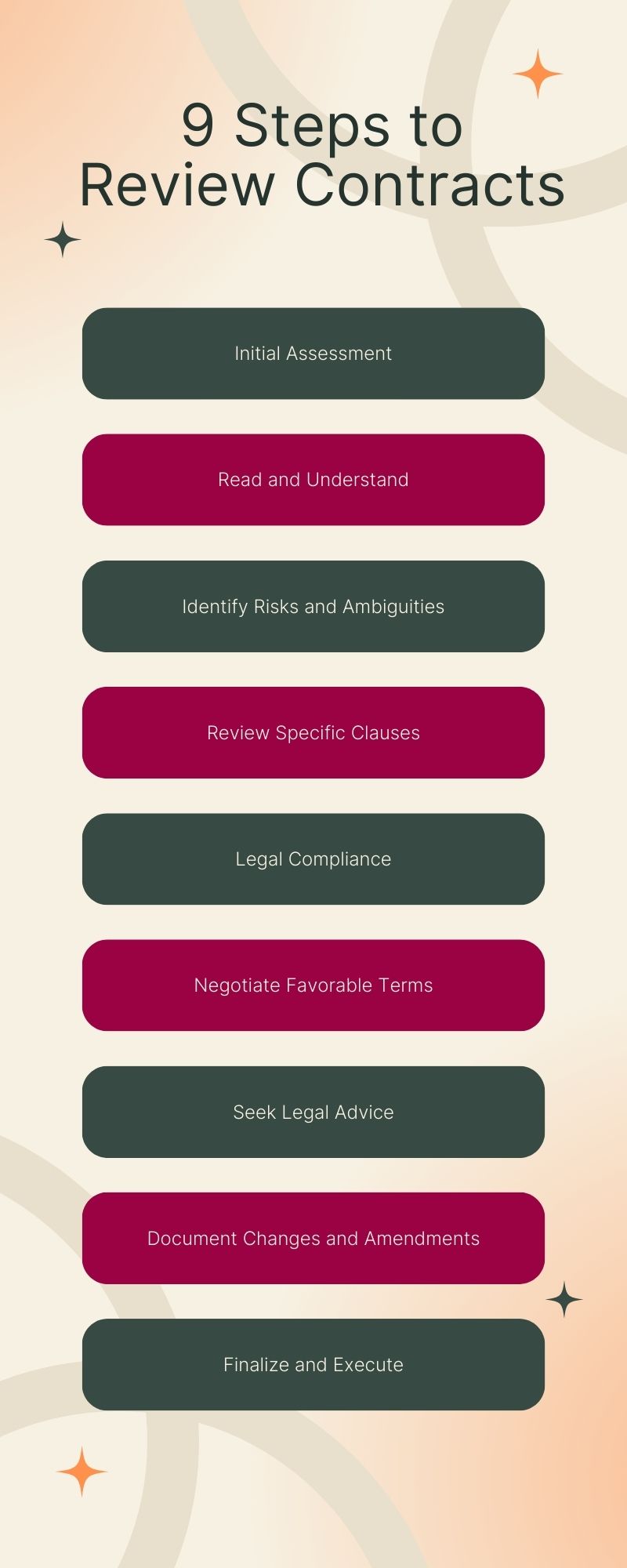
Understand the contract’s purpose, scope, and parties involved. Identify critical areas that require special attention, such as payment terms, indemnification clauses, intellectual property rights, and termination provisions.
Thoroughly read the contract, paying attention to each clause, provision, and obligation. Ensure clarity of language, consistency, and coherence.
Look for potential risks, ambiguities, or loopholes that may lead to unfavorable outcomes or disputes. Consider legal, financial, operational, and reputational risks.
Analyze key clauses, such as indemnification, limitation of liability, dispute resolution, confidentiality, and termination provisions. Assess their fairness, reasonableness, and alignment with your objectives.
Ensure that the contract complies with applicable laws, regulations, and industry standards
If you identify unfavorable or ambiguous terms, consider negotiating with the other party to achieve a mutually beneficial agreement. Propose revisions or alternative language that better aligns with your interests.
Consult with legal professionals when necessary, especially for complex or high-stakes contracts. They can provide guidance, ensure legal compliance, and offer insights on potential risks and negotiation strategies.
Maintain a clear record of any contract redlining, amendments, or revisions made during the review process. Clearly communicate and document agreed-upon modifications to ensure all parties are aware of the updated terms.
Once the contract review is complete, ensure all parties are satisfied with the terms. Execute the contract automation according to the agreed-upon process, obtaining necessary signatures and authorizations.
Contract review is a meticulous process, and certain common mistakes can be avoided by following best practices:
You may also like: How to write a contract proposal
A comprehensive contract review checklist can help guide the review process. While specific checklists may vary based on the contract type and industry, here are some general items to consider:
You may also like: Blockchain contract management
Legitt AI offers significant support in the contract review process by leveraging its advanced AI capabilities and legal expertise. Here’s how Legitt AI can assist:
Contract review is a critical process that requires careful attention to detail, legal compliance, and risk mitigation. Leveraging contract review software, such as Legitt AI, can greatly enhance the efficiency and effectiveness of the review process.
Did you find this Legitt article worthwhile? More engaging blogs about smart contracts on the blockchain, contract management software and electronic signatures can be found in the Legitt Blogs section. You may also contact Legitt to hire the best contract lifecycle management services and solutions along with free contract templates.
Yes, a lawyer typically reviews contracts to ensure their legality, compliance, and protection of their client's interests. They analyze the terms, assess potential risks, negotiate favorable terms, and provide legal advice regarding the contract's implications.
The purpose of the contract review process is to critically examine and assess the terms, clauses, and provisions of a contract to identify potential risks, ensure accuracy, protect parties' interests, negotiate favorable terms, and ensure legal compliance.
A contract review form is a structured document or template used to systematically assess and document the analysis of a contract. It typically includes sections or fields for recording key contract details, identifying risks, suggesting revisions, and documenting the overall review process and outcomes.
The stages of contract review typically include initial assessment, reading and understanding the contract, identifying risks and ambiguities, reviewing specific clauses, negotiating terms, seeking legal advice if necessary, and finalizing the contract execution.
A contract review checklist is a tool used to ensure a comprehensive and systematic examination of a contract. It typically consists of a list of key elements and provisions that need to be reviewed, ensuring that no critical areas are overlooked during the contract review process.
Key terms in a contract review refer to the critical elements and provisions that require thorough analysis and assessment. These may include payment terms, indemnification clauses, termination provisions, dispute resolution mechanisms, intellectual property rights, and confidentiality obligations.
The time it takes for a lawyer to review a contract can vary depending on various factors, such as the complexity of the contract, the lawyer's workload, and the specific requirements of the review. It can range from a few hours to several days, or even longer for highly complex agreements.
The four stages of a contract are:
• Formation: Parties negotiate and agree on the terms and conditions of the contract.
• Performance: Parties fulfill their obligations as outlined in the contract.
• Breach: One or more parties fail to meet their contractual obligations.
• Remedies: Parties seek legal remedies for any breaches or disputes that arise from the contract.