
Contracts are fundamental to business transactions, providing a framework for the exchange of goods, services, and promises. Two critical components of contracts are warranties and representations. While they may seem...


Contracts are fundamental to business transactions, providing a framework for the exchange of goods, services, and promises. Two critical components of contracts are warranties and representations. While they may seem similar, understanding their distinctions is crucial for both parties in a contractual relationship. This article delves into the nuances of warranties and representations, exploring their legal implications and the importance of distinguishing between them.
In contract law, warranties and representations are vital yet distinct components with different legal implications. Representations are statements of fact made before or at contract formation to persuade the other party into the agreement. If a representation proves false, it may lead to a claim for misrepresentation, potentially resulting in contract rescission or damages. Warranties, however, are promises within the contract that certain facts are true, forming an enforceable part of the contract’s terms. Breaching a warranty allows the affected party to seek damages but does not necessarily justify contract termination. Understanding these differences is crucial for managing legal risks, as misclassifying these elements can impact remedies and liability. Clear drafting that distinguishes representations from warranties reduces ambiguity and protects both parties’ interests, ensuring well-defined expectations in business transactions and minimizing potential disputes.
Representations are statements of fact made by one party to another before or at the time of contracting. They are designed to induce the other party into entering the contract by providing information about certain conditions or circumstances.
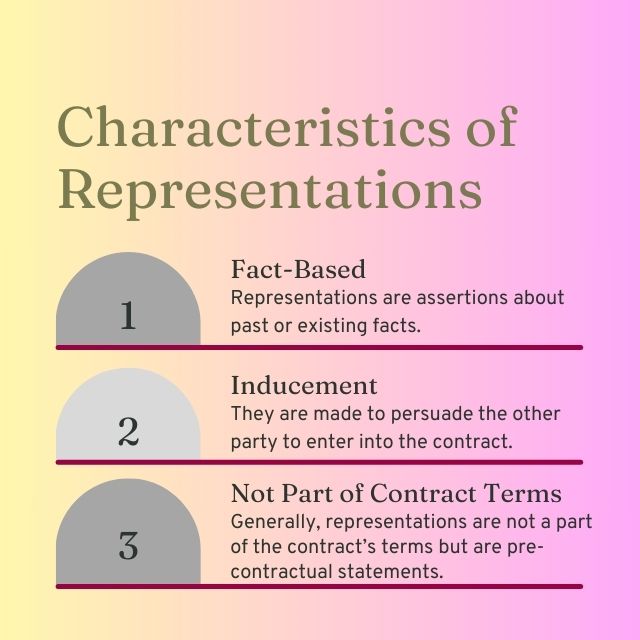
If a representation is found to be false, it can lead to a claim for misrepresentation. Depending on the nature of the misrepresentation (fraudulent, negligent, or innocent), remedies may include rescission of the contract or damages.
Warranties are assurances or guarantees that certain facts or conditions about the subject of the contract are, or will be, true. They are part of the contract’s terms and provide a basis for the contract’s performance.
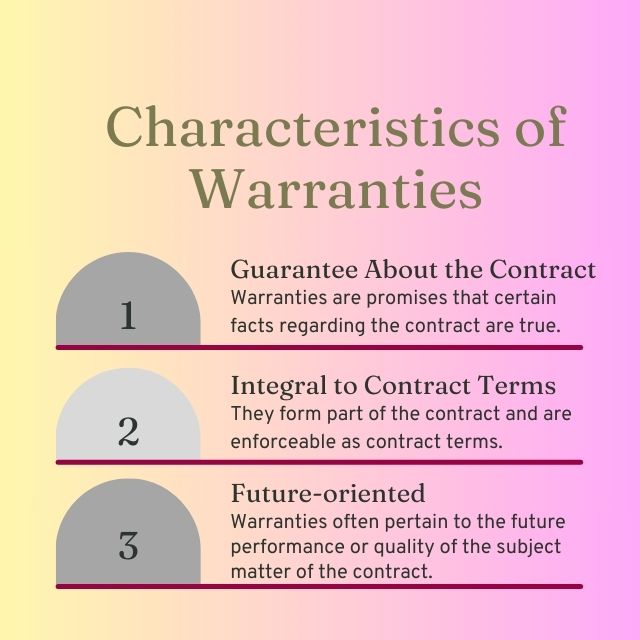
Breaching a warranty allows the non-breaching party to claim damages. However, it does not necessarily entitle them to terminate the contract unless the warranty is a condition, a term so essential that any breach of it justifies termination.

Complete contract signing in minutes effortlessly with Legitt AI.
Get Started FreeThe key differences lie in their nature and the legal consequences of their breach:
Understanding the difference between warranties and representations is crucial for several reasons:
Analyzing real-life cases provides insight into how courts interpret warranties and representations. These cases often illustrate the importance of clear language and the implications of categorizing a statement incorrectly.
International Perspectives
The treatment of warranties and representations may vary in different legal systems. In some jurisdictions, the distinction might be less pronounced, while in others, like the United States and the United Kingdom, it is more clearly defined.
Best Practices in Contract Drafting
To avoid confusion and potential legal disputes, it’s important to:
The Role of Legal Counsel
Seeking legal advice is essential in drafting contracts that accurately reflect the parties’ intentions and in understanding the legal implications of warranties and representations. Lawyers can provide clarity and guidance on how to structure these elements effectively.
In contract law, the distinction between warranties and representations is more than a matter of semantics; it has significant legal implications. While representations are pre-contractual statements that induce the formation of a contract, warranties are promises within the contract about the truth of certain facts. Misunderstanding or misclassifying these elements can lead to unforeseen legal consequences, emphasizing the need for clarity and precision in contract drafting. By understanding these differences and their implications, parties can better protect their interests and foster more secure and effective contractual relationships.
Did you find this Legitt article worthwhile? More engaging blogs about smart contracts on the blockchain, contract management software and electronic signatures can be found in the Legitt Blogs section. You may also contact Legitt to hire the best contract lifecycle management services and solutions.
A representation is a statement of fact made before or at the time of contracting, intended to persuade the other party to enter the contract.
A warranty is a promise within a contract that certain facts about the contract's subject are true.
Representations are pre-contractual statements of fact, while warranties are guarantees within the contract itself.
A false representation can lead to a misrepresentation claim, with remedies including rescission of the contract or damages.
Breaching a warranty leads to a breach of contract claim, typically resulting in damages.
Generally, a false representation allows for rescission, which effectively terminates the contract.
The distinction affects legal remedies, risk allocation, and how parties draft and interpret contracts.
Warranties often pertain to future performance or quality but can also assure current facts.
Most contracts include warranties and representations, but their presence and extent depend on the contract's nature and terms.
Use clear language to categorize statements, define terms within the contract, and understand the legal consequences of each.