
In the multifaceted realm of legal agreements, the nuances between express and implied contracts play a pivotal role in defining the boundaries and obligations of the parties involved. For businesses...


In the multifaceted realm of legal agreements, the nuances between express and implied contracts play a pivotal role in defining the boundaries and obligations of the parties involved. For businesses and individuals navigating the complexities of contractual relationships, a clear understanding of these distinctions is not just beneficial; it’s essential. Express contracts are usually straightforward, characterized by clearly articulated terms and conditions that are either written or verbally communicated. They represent the quintessential model of contractual agreements, where everything is laid out with precision and clarity.
Conversely, implied contracts operate in a more subtle and often complex domain. These contracts are formed not by explicit words but through the conduct, actions, or circumstances of the parties involved. They rely on unspoken understandings and assumptions, which can be inferred from the behavior or the situational context of the contractual relationship. While not as overt as express contracts, implied contracts are equally binding and enforceable, yet they carry a level of ambiguity that can lead to unique legal challenges and interpretations.
This article delves into the intricate differences between these two fundamental types of contracts. By exploring their respective characteristics, legal standings, and practical implications, we aim to provide a comprehensive understanding of how express and implied contracts operate in the real world. We’ll examine how these contracts are formed, their enforceability, and the typical scenarios where each type is prevalent. Understanding these concepts is crucial for anyone engaged in contractual relationships, whether in personal dealings, business transactions, or more complex legal arrangements. Through this exploration, readers will gain insight into how both express and implied contracts shape and influence the dynamics of legal obligations and rights.
Express contracts stand as a fundamental component in the realm of legal agreements, distinguished by their clarity and explicitness. These are the types of contracts most people envision when they think of agreements. In an express contract, the terms and conditions are laid out with precision, leaving little room for interpretation or ambiguity. Whether articulated orally or in writing, express contracts are about clear communication and mutual understanding.
Express contracts are defined by several key characteristics, each contributing to their straightforward nature.
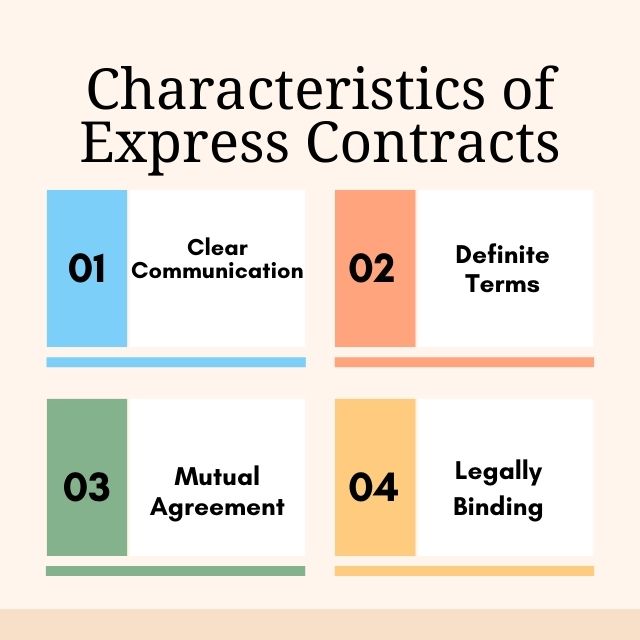
Express contracts are the cornerstone of business transactions, providing a foundation of clarity and predictability in a diverse range of commercial activities. These contracts, known for their explicit terms, play a vital role in streamlining business operations and mitigating potential disputes. They are commonly employed in a variety of settings, from straightforward purchase agreements to intricate service contracts, catering to the dynamic needs of the business world.
Express contracts find their application in various aspects of business. They are not limited to sales and service agreements but extend to employment contracts, leasing agreements, partnership agreements, and more. In each scenario, the clear terms set out in an express contract provide a framework that guides the conduct of the parties involved.
In summary, express contracts are indispensable in the business world for their role in ensuring clarity, legal certainty, and operational efficiency. They reduce the risk of conflicts, streamline business operations, and build a foundation of trust and cooperation. Their straightforward and unambiguous nature makes them a reliable tool for outlining and safeguarding the rights and responsibilities in a multitude of business transactions. For anyone navigating the complexities of business dealings, a thorough understanding and effective utilization of express contracts are vital for success and legal compliance.
Read More: Implied Contract: Definition, Example and Types
In the legal tapestry of contracts, implied contracts present a unique and nuanced dimension. These contracts differ significantly from express contracts in that they are not explicitly stated in written or oral form. Instead, they are inferred from the actions, conduct, or circumstances of the parties involved. Despite their subtle nature, implied contracts are as legally binding as their express counterparts, offering a framework for fairness and obligation in situations where formal agreements are absent.
Implied contracts are primarily of two types:
Implied contracts share several common characteristics:
Navigating the legal complexities of implied contracts can be particularly challenging due to their inherent non-explicit nature. Unlike express contracts, where the terms are clearly defined and documented, implied contracts require a judicial interpretation of behaviors and circumstances. This interpretation is crucial to establish the existence and terms of such a contract.
Implied contracts play a significant role in everyday life, often without explicit acknowledgment by the parties involved. In many common transactions and interactions, there are unspoken agreements that guide our conduct.
In the legal arena, both express and implied contracts hold significant weight and are enforceable, but the manner in which their terms are established and proven in court differs markedly. This distinction is crucial in understanding how these contracts are interpreted and executed in real-world scenarios.
Express contracts are typically straightforward to enforce due to the clarity of their terms. These contracts are laid out with explicit detail either through written documentation or verbal agreements. The clear evidence of terms, such as signed documents, emails, or recorded conversations, provides concrete proof of the agreement and its specifications. This explicitness simplifies the legal process, making it relatively uncomplicated to establish the terms in a dispute.
Implied contracts, on the other hand, pose more of a challenge in terms of legal enforcement. These agreements rely on the conduct and expectations of the parties involved, which can often be subjective and open to interpretation. To prove an implied contract in court, one must demonstrate a pattern of behavior or a set of circumstances that imply an agreement. This could involve showcasing a history of actions, reliance, and an established relationship between the parties, which suggest a mutual understanding, even in the absence of explicit terms.
In conclusion, both express and implied contracts are pivotal in legal and practical contexts, each serving essential roles in various domains. Understanding their differences, legal enforceability, and applications is key to navigating the complexities of contractual relationships. Whether in business transactions, employment, or service industries, these contracts form the backbone of countless interactions and exchanges, highlighting the versatility and scope of contract law.

The main challenge with implied contracts is the ambiguity in proving their existence and terms. Disputes can arise from differing interpretations of actions and assumptions, leading to legal complexities.
Effective management of contractual relationships is pivotal in ensuring successful business operations and legal compliance. Understanding the nuances between express and implied contracts and implementing best practices can significantly reduce risks and enhance the efficiency and clarity of agreements.
In long-term business relationships, it’s crucial to maintain a record of interactions, especially where implied terms might come into play.
Legal counsel can be invaluable in navigating the complexities of contract law.
Grasping the differences between express and implied contracts is crucial for navigating the complex landscape of contractual obligations. Express contracts, with their clarity and straightforward enforcement, are generally preferable. However, implied contracts, which are equally binding, necessitate a deep understanding of unspoken terms and conduct.
Employing best practices like preferring express contracts, documenting interactions, clear communication, and seeking legal advice is imperative for managing these relationships effectively. As the business environment evolves, adeptness in recognizing and handling both express and implied contractual elements remains a critical skill for success and compliance. Adhering to these practices ensures that contractual relationships are not only legally sound but also mutually beneficial and aligned with business goals.
Did you find this Legitt article worthwhile? More engaging blogs about smart contracts on the blockchain, contract management software and electronic signatures can be found in the Legitt Blogs section. You may also contact Legitt to hire the best contract lifecycle management services and solutions.
An express contract is a clear agreement where terms and conditions are explicitly stated, either orally or in writing, leaving little to no room for ambiguity.
An implied contract is formed based on the actions, conduct, or circumstances of the parties involved, rather than explicit words, and is inferred from the situation.
Yes, implied contracts are legally enforceable, but proving their existence and terms in court can be more challenging compared to express contracts.
The main challenges include ambiguity in proving their existence and terms, evidentiary difficulties, and potential misinterpretation of conduct leading to disputes.
Proving an implied contract typically involves demonstrating a clear pattern of behaviour or circumstances that reasonably infer the contract's terms.
Prefer express contracts for clarity, document interactions, communicate clearly in all dealings, and seek legal advice for drafting contracts and understanding implications.
Clear communication is crucial in avoiding misunderstandings and disputes in both express and implied contracts.
Express contracts are preferred for their clarity, explicit terms, and ease of enforcement, reducing the risk of legal complications.
Yes, regular interactions in ongoing business relationships can imply certain terms and expectations, forming an implied contract.
Legal professionals help understand the implications of implied terms, draft effective express contracts, and provide guidance on contractual obligations.